Objective 1 · Record
Capturing human development in the real world
An agent can only learn from the experience it is given. To build agents that learn as people do, we first need a record of experience as a person actually lives it: bounded, multimodal, and ordered in developmental time.
The idea
A typical developmental study observes a child for an hour in the lab. The first 1,000 days of life contain roughly 12,000 waking hours, so a single visit samples about one ten-thousandth of the period it is meant to characterize. Two properties of a dataset matter. Density shows how one individual actually learns, including the rare events that shape a trajectory. Diversity shows which mechanisms are shared across people and which depend on a particular home, culture, or history. Every real dataset trades one against the other. We chose density.
In practice: The First 1,000 Days Project
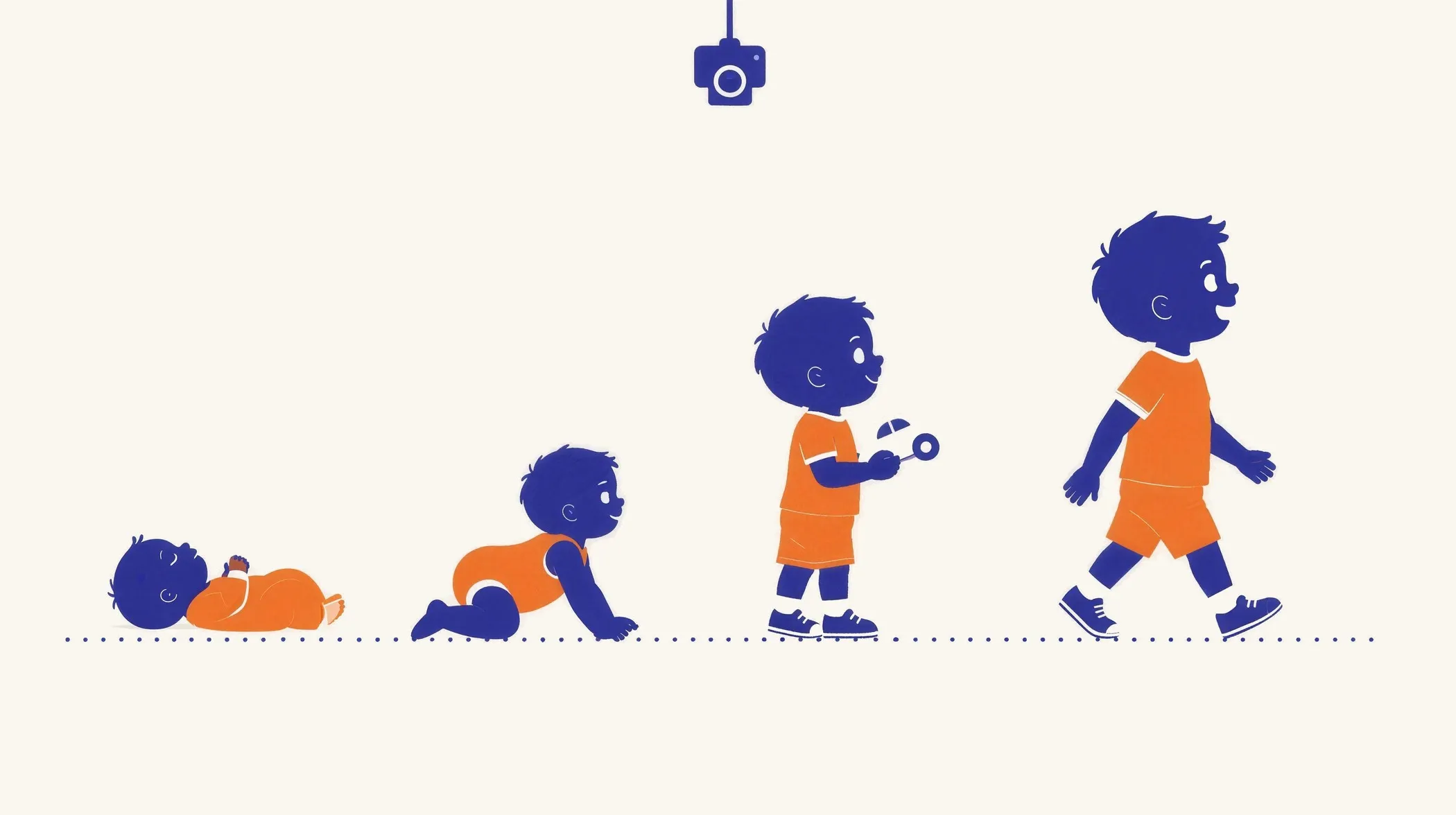
With Casey Lew-Williams and the Princeton Baby Lab, we recorded 17 infants in 15 racially and economically diverse U.S. households for 12 to 14 hours a day, for a median of 944 days, using cameras and microphones placed throughout each home. The result is not a sample of childhood but a near-continuous record of it.
Every family chose to take part and stayed in control throughout, free to pause the recording or delete any part of it. The recordings are stored securely, seen only by approved researchers, and never shared publicly.
No two childhoods are alike. Every home has its own words, routines, and bedtime songs. One child hears about tractors and rain. Another hears about subways and soccer. Each child learns from the life they actually live, and no one else lives it. A brief visit cannot see this. An hour in the lab catches a moment, and averaging across many children blurs each one into a child who never existed. To understand how a child develops, a snapshot is not enough. We need the whole film. Day after day, word after word, until the shape of one childhood comes into view. That is what dense recording gives us: not childhood in general, but this child’s world, as they lived it and learned from it.
Read the methods paper
The First 1,000 Days (1kD) Project: Collecting and Analyzing an Ultra-Dense Naturalistic Dataset of Human Baby DevelopmentRaviv H, Hasenfratz L, Gousios K, Faryna M, Beaty R, Johnson D, Chen B, Altenhof A, Ryan B, Greenberg CA, et al. 2026. bioRxiv.