Objective 2 · Build
Agents that learn as humans do
Large language models pass the behavioral test: they converse, answer questions, and generalize to new input. But they learn from a volume of text no human could digest, shuffled and stripped of context. We build agents that learn under human constraints and hold them to a human standard: the developmental trajectory of one real child.
Same speech
The idea
Modern AI rests on a few compact principles: predict what comes next, attend to what is relevant, reweight by reward. Each is a precise hypothesis about a computation the mind may perform on natural input. We rebuild these principles inside a cognitively feasible learner, with feasible input, a feasible learning procedure, and a feasible behavioral target. A model that learns faster than any child is not a better model of acquisition. It learned something other than what children learn.
In practice: giving an agent a childhood
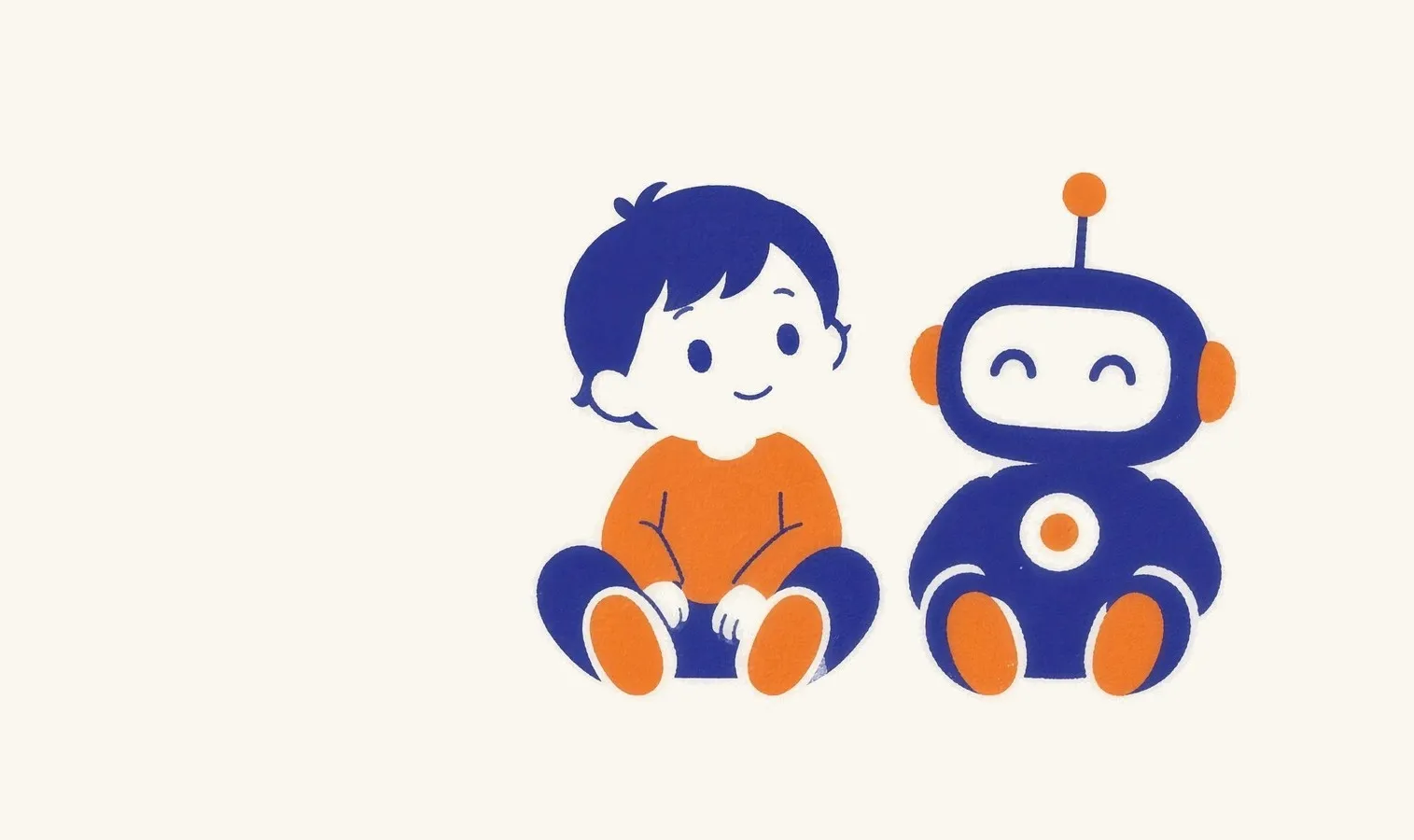
We built an agent that begins as a newborn does. It knows no sounds and no words. It has no sense of where one word ends and the next begins, and it never sees a line of text. Then we gave it a childhood. It listened to the speech that surrounded one real child, in order: day one, then day two, then day three, for hundreds of days. Only a record this dense makes that possible. No one can live through a childhood sampled an hour at a time.
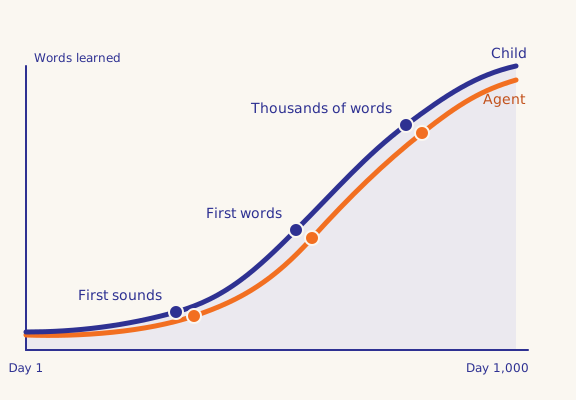
At first, the agent failed. It listened to an immense amount of speech and retained almost none of it. So we looked to sleep. In sleep, the brain revisits the day and replays its moments. We gave the agent the same quiet interval: at the end of every day, it replayed a fragment of what it had recently heard. That was enough. With replay, the agent discovered the sounds of English, and then thousands of words.
We ran the same process in eight homes. The agent succeeded in every one, no matter how different the families. But it learned at the same pace in every house, and real children do not. Some build a vocabulary before their first birthday; others take nearly another year to reach that point. A child’s path depends on two forces. The environment changes from house to house, and so does the brain that meets it.
To close that gap, we had to change the agent too. We altered just three things: how much it replayed each night, how quickly it learned, and when it began to learn words. With those adjustments, each agent grew on the schedule of its own child. The model can now separate what comes from the environment from what comes from the child’s own mind.
This is a starting point. Today the agents only listen. Next they will need eyes to see the scene, people who respond to them, and a body that acts.
Raviv H, Tsyhanov A, Gousios K, Altenhof A, Wang H, Chen B, Raviv O, Rosenwein T, Lew-Williams C, Hasenfratz L, et al. 2026. Science, in Press.